

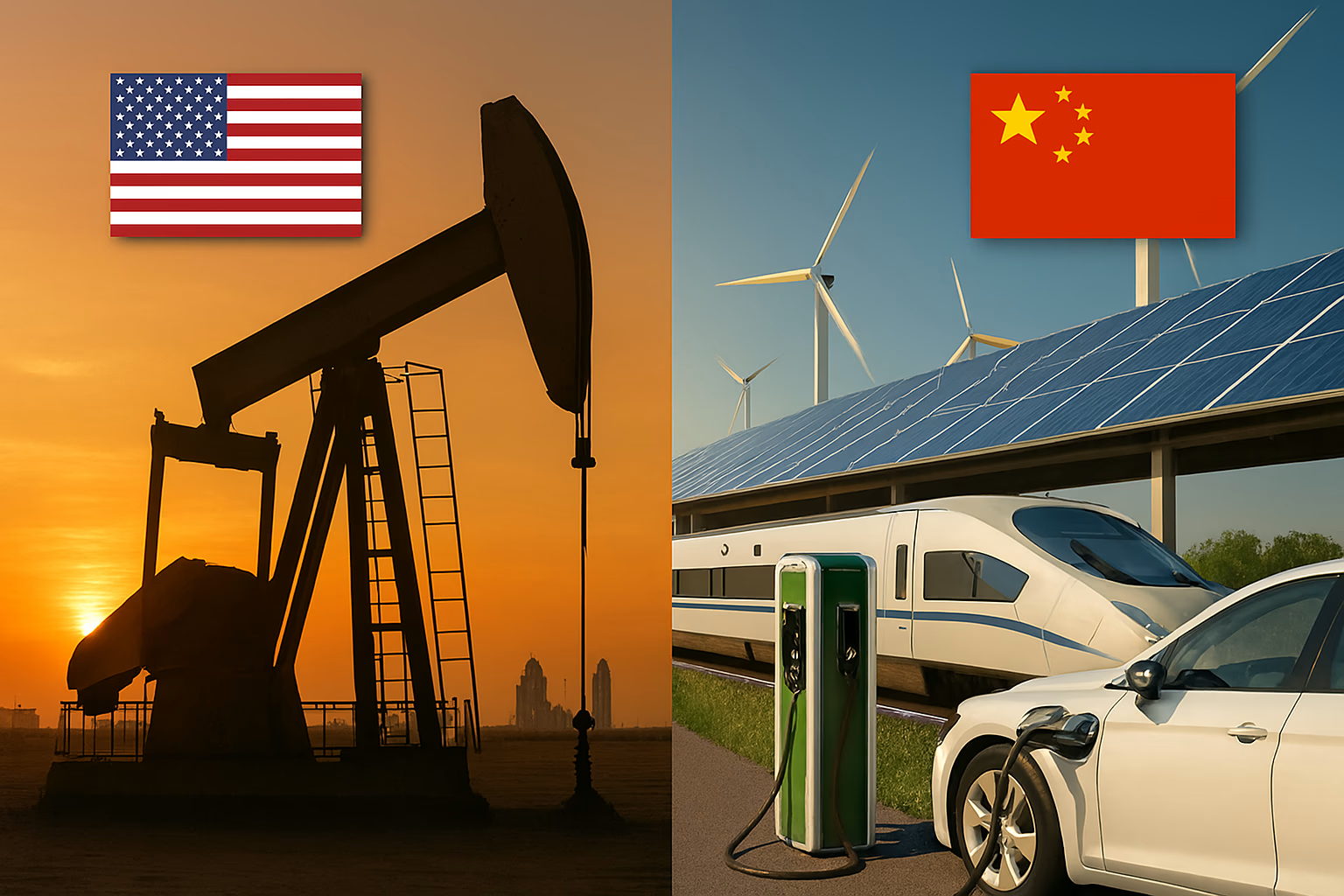
The United States now controls the flow of Venezuelan oil “indefinitely,” rerouting what was once China’s largest source of discounted crude. But as Washington tightens its grip on 20th-century energy assets, Beijing is building the 21st-century alternative.
BREAKING NEWS: The United States now controls the flow of Venezuelan oil “indefinitely,” rerouting what was once China’s largest source of discounted crude. Washington’s bold move, framed as leveraging oil sales to force political change in Venezuela, has directly seized the spigot that once fueled China’s massive refining sector. But as the US tightens its grip, a far more profound shift is quietly dismantling the very foundation of 20th-century energy geopolitics: China itself is walking away from oil.
This isn’t just another resource skirmish. It’s the first major geopolitical crisis of the new energy era, where the world’s largest oil importer is also the world’s fastest-growing green energy superpower. The US may have won the battle for Venezuela’s barrels, but China’s headlong rush into electric vehicles (EVs) and high-speed rail is winning the war for the future.
The US Move: Seizing the Spigot
In a stunning geopolitical power play, the United States has taken physical and financial control of Venezuela’s sanctioned oil exports. The plan is for the U.S. government to market 30-50 million barrels of oil, with all revenue flowing into U.S.-controlled accounts before any trickles back to Venezuela. Energy Secretary Chris Wright stated the U.S. will maintain this control “indefinitely” to “drive the changes that simply must happen in Venezuela”.
The Immediate Target? China.
Prior to the U.S. intervention, more than half of Venezuela’s crude exports—roughly 400,000 barrels per day (bpd)—were flowing to Chinese refineries, primarily small, independent plants known as “teapots” that thrive on the deep discounts of sanctioned oil. This flow is now severely disrupted or completely halted.
The Stakes for China in Venezuela:
- Oil Debt: Venezuela owes China an estimated $10–12 billion in oil-for-loan deals, with repayment now frozen.
- Strategic Investments: Chinese national oil companies have joint ventures in Venezuela’s heavy oil fields. Their future role is now uncertain as the U.S. prioritizes American companies to rebuild the industry.
- Geopolitical Signal: U.S. officials explicitly state a goal of limiting “non-hemispheric competitors” in the Western Hemisphere, directly challenging China’s influence in Latin America.
China’s Counter-Move: Building the Green Wall
Just as the U.S. cuts off one supply, China is systematically reducing its need for all supply. The data points to a historic, structural shift.
The EV Revolution in Numbers
New Energy Vehicles (NEVs, including battery electric and plug-ins) accounted for over 50% of new car sales in China as of August 2025. Analysts from JP Morgan to PetroChina’s own research institute project that China’s gasoline demand has already peaked (likely in 2023-2024) and will now enter permanent decline.
Beyond Cars: The Transport Transformation
China’s world-dominating high-speed rail network has already displaced the need for an estimated 300,000 bpd of oil that would have been used in road and air transport.
Economic Rebalancing
A severe property sector slump has crushed demand for diesel used in construction, while a surge in natural gas-powered trucks is displacing diesel in freight.
The result? China’s oil demand growth, which once drove half of global growth, has slammed on the brakes. The International Energy Agency slashed its 2024 growth forecast for Chinese demand from 410,000 bpd to just 180,000 bpd. Some analysts see growth below 100,000 bpd.
A Tale of Two Energy Paradigms
| Factor | The Old Energy World (Disrupted) | The New Energy Reality (Emerging) |
|---|---|---|
| Primary Lever | Control of physical resource flows (oil, gas) | Control of manufactured technology (batteries, EVs, renewables) |
| Geopolitical Power | Derived from oil reserves & supply chains | Derived from clean tech manufacturing dominance & market creation |
| China’s Position | Vulnerable importer, reliant on secure shipments | Insulating through electrification; becoming a self-sufficient tech exporter |
| U.S. Leverage in Venezuela | High (can physically divert oil shipments) | Potentially declining (as target’s need for the resource wanes) |
The Billion-Barrel Question: Is China Stockpiling or Stalling?
Here’s where the controversy ignites. Even as demand growth flatlines, China has been importing massive volumes of crude to fill its strategic petroleum reserves. In 2025, it was stockpiling at a rate of roughly 1 million bpd. Its storage caverns are only half-full, with massive new capacity coming online.
Two Opposing Narratives Clash:
This group sees the stockpiling as a short-term anomaly. They argue the underlying demand story is broken. The structural forces of EVs, rail, and a changed economy mean China’s total oil demand could peak before 2030. The loss of Venezuelan oil is a nuisance, not a crisis, because the need for it is evaporating.
This view warns that dismissing China’s oil appetite is naive. The stockpiling, they argue, shows Beijing is preparing for long-term supply disruptions or future growth in petrochemicals (plastics, fertilizers). A report from OilPrice.com notes that China’s vigorous buying is creating market stability and “masking” underlying demand weakness. In this view, control of resources still matters deeply.
The truth likely lies in the messy middle. China is both building a final buffer against geopolitical shock and navigating the early stages of a historic energy transition. The U.S. move in Venezuela tests which of these impulses is stronger.
⚡ The Global Ripple: Who Wins the New Energy Game?
The Venezuela-China-U.S. triangle is a microcosm of the global energy realignment.
For the U.S.:
Short-term tactical victory. It regains influence in its hemisphere, redirects oil to its own refineries, and strikes a blow at a key Chinese resource link. But the long-term strategic value diminishes if the target market (China) is weaning itself off the product.
For China:
Short-term pain for long-term positioning. Losing cheap Venezuelan crude hurts specific refiners and complicates debt collection. However, it accelerates Beijing’s push for energy security through electrification and renewables, reducing its greatest strategic vulnerability: reliance on seaborne oil.
For the World:
The incident signals that the era of oil-centric geopolitics is entering its turbulent final chapter. Future crises may not be about who controls the oil fields, but who controls the lithium mines, battery supply chains, and EV markets. Countries like India and Southeast Asia are now expected to drive nearly all future global oil demand growth, becoming the new center of gravity for traditional energy markets.
💬 The DriveZA Energy Debate
Is the US seizure of Venezuelan oil a masterstroke of 20th-century statecraft, applied too late in the 21st century? Or is China’s green transition an overhyped narrative, leaving it dangerously exposed to resource nationalism?
What’s your take? Is control of oil still the ultimate geopolitical prize, or has the world already moved on?
SHARE YOUR THOUGHTS IN THE COMMENTS
Follow #DriveZA for more cutting-edge analysis on the future of energy and transport


